
Industry:
3PL
Solutions:
Dock Scheduling
Driver Check-In
Documentation
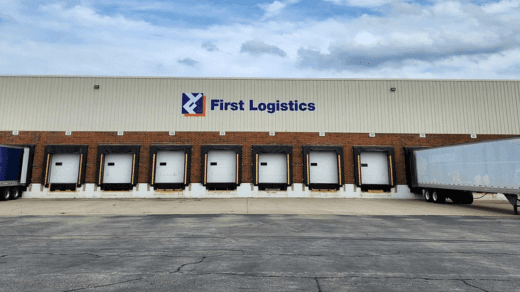
First Logistics has been solving complex logistics problems since 2003. As a multi-client 3PL operating roughly 2 million square feet across five Chicago-area warehouses, the company manages customers with different products, carrier networks, and handling requirements.
“I like that logistics is like a big puzzle,” said President Karen Galena. “You’re always looking for ways of making our customers more efficient, and you can see the impact of what you’re doing.”
General Manager Don Worth, who has been with First Logistics since day one, has seen that puzzle become harder to coordinate over time. Managing different customers, carriers, and labor planning across multiple facilities took dedicated people and a great deal of manual coordination.
At the same time, larger customers and prospects were asking for more: a scheduling tool, better visibility into carrier performance, and a more modern experience at the dock.
What began as a search for a dock scheduling solution became something bigger. With Conduit, First Logistics moved from manual coordination to a more controlled, transparent, and data-driven way of operating.
Challenge
At First Logistics, too much of its complex, multi-client operation still depended on manual coordination. Scheduling lived in calendars and email threads, driver check-in happened at the warehouse window, and documentation was not organized in a way that could easily support disputes, customer questions, and performance reviews.
Scheduling depended on people, not a system
Before Conduit, inbound and outbound appointments were managed through Microsoft Outlook calendars, email threads, and phone calls between carriers, customers, and customer service teams. Every customer’s scheduling rules, lead times, and requirements lived in people’s heads rather than in a system.
"In a multi-client warehouse, no two customers operate the same," said Don. "Their carriers run differently. Their scheduling runs differently. Without scheduling software, it took a lot to manage that different client base."
Customer service representatives (CSRs) were spending more than 50 hours a week going back and forth with carriers to book, adjust, or confirm appointments.
Operations leaders juggled dock capacity and labor planning without a unified, real-time view of what was coming. And across multiple facilities, every site was managing its own version of the same manual process.
Driver check-in created unnecessary friction
The check-in process was entirely in-person. Drivers parked, walked into the warehouse, signed in at a window, and waited to be assigned a door. That meant more foot traffic in operational areas, more interruptions for staff running the floor, and a slower, less predictable arrival flow.
No defensible record when disputes arose
Detention was a recurring friction point. Carriers sometimes claimed they were on time or early without clear proof. And without system-generated timestamps they could trust, First Logistics had little to push back with.
"It's hard to dispute off of a paper log when a driver signs in or when a driver doesn't sign in," Don explained.
Paper sign-in sheets and manual notes made detention disputes feel like a ‘he said, she said’ situation, with real dollars on the line.
Customers expected more
Customer expectations were rising. Larger customers and prospects were explicitly asking for a scheduling tool, better visibility into carrier performance, and real-time access to documents.
First Logistics also knew there was more value in the data around appointments, check-ins, and load activity than their manual processes were capturing.
In a multi-client operation, that meant missing opportunities to better understand service levels across customers, carriers, and handling requirements.
Solution
How Conduit fits into First Logistics’ operation today
Conduit replaced the array of manual processes with a single connected system for dock scheduling, driver check-in, and documentation across First Logistics' facilities.
Dock scheduling with a carrier self-service portal and enforced rules
Before Conduit, every appointment required a customer service rep to field a call or email, confirm availability, and manually update a calendar. Now, carriers can self-serve — booking, rescheduling, or canceling appointments directly in Conduit without calling or emailing. Today, roughly 80% of appointments are booked self-serve through the portal. The rest are special client requests that need extra attention.
Appointment requirements like lead times and scheduling windows are configured to match each customer's needs, so bookings arrive within First Logistics' rules instead of creating exceptions that need to be sorted out later.
The result is a unified dock schedule that reflects real capacity—not a patchwork of calendars that requires someone to reconcile.
"It has let our customer service team be more dedicated to customer service and not carrier service or appointment scheduling" said Don.
Contactless Driver Check-In
Conduit also transformed the arrival experience. Instead of parking, walking into the warehouse, and signing in at a window, drivers now check in from their cab using a QR code posted in the parking lot.
Scanning the code opens a mobile web form—no app download required—where drivers provide required information like their MC number, trailer number, and reference numbers, and can upload documents like a bill of lading. Conduit ties the check-in to the correct appointment automatically, and once processed, the driver receives dock assignment and yard instructions via text.
"We have a sign right in the parking lot so drivers can pull up and sign in, get assigned a dock," said Galena. "They can do everything without having to get out of their truck and come in. It has helped reduce a lot of the warehouse traffic."
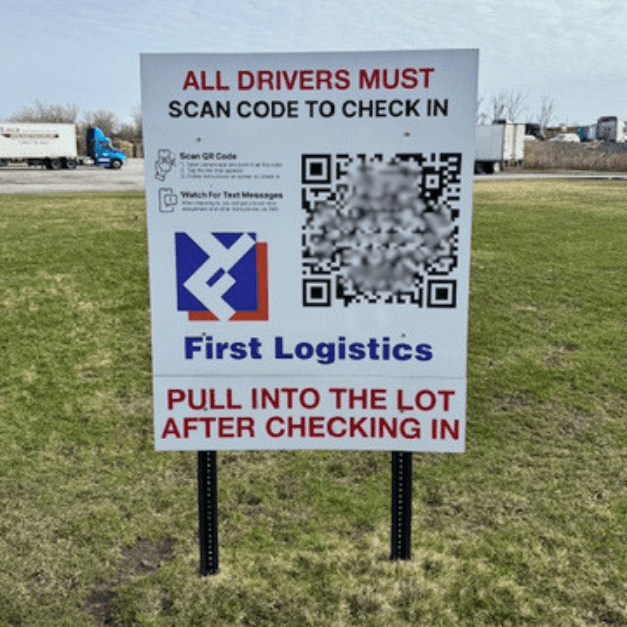
For First Logistics, this means less congestion, fewer interruptions for floor staff, and a faster, more predictable check-in flow. For drivers, it means a faster, more predictable check-in that respects their time — an increasingly important factor as driver shortages make dock experience a competitive differentiator for facilities. Today, approximately 85% of drivers check in through the mobile flow.
A single record for every load
As the system for dock scheduling, driver check-in, and documentation, Conduit creates a complete, digital record for every load.
That record includes:
Time-stamped milestones including when the appointment was scheduled, when the driver checked in, when work started, and when it was completed.
Shipment paperwork such as signed bills of lading (BOLs), PODs, and other uploaded documents.
Photo proof captured using any handheld device. Galena said the team especially values being able to “take a picture and file it right to that load.”
All communication, including messages and photos from drivers.
For First Logistics, that means each shipment carries a complete history in one place instead of being spread across paper logs, email threads, phones, and disconnected files.
Don emphasized the value of having a digital archive: “We’ve been using it for going on two years now, and I’ve been able to search things from when we initially implemented Conduit, which has been great.”
Self-serve proof for customers
That record is not just useful internally. Through Conduit’s portal, First Logistics’ customers can access records tied to their shipments.
Customers can review documents, photos, and shipment details without relying on a CSR to track them down. As Don put it, “They just log right into the portal and they find everything that they need without even having to reach out to us.”
That is especially valuable when questions come up around claims, detention, or shipment status. Instead of asking First Logistics to reconstruct what happened, customers can pull the proof themselves and use it where needed.
Data and analytics
As the system used to manage appointments, check-in, and load documentation, Conduit can aggregate operational data and provide analytics at the carrier, facility, and network level.
That gives First Logistics more than a view of what happened with one shipment. In Conduit, First Logistics can see appointment activity, time at facility, detention time, average load, unload, and dwell time, top carriers, and other operational trends at a single site or across the broader network.
Conduit also provides carrier scorecards. First Logistics can use them to review how carriers are performing, from appointment outcomes to arrival timing, and compare carriers side by side. This makes it easier to spot patterns, identify recurring issues, and have data-backed conversations around carrier performance.
All analytics views are filterable, so the team can narrow the data by date range, direction, customer, carrier, or shipper/receiver depending on what they want to understand. When they need to take that information into a customer conversation or internal review, they can export it directly from the system rather than rebuilding it from separate records.

Fast implementation and multi-facility rollout
First Logistics started with Conduit at its central facility and got it up and running quickly.
Don described the implementation as “basically seamless,” noting that the team was able to make adjustments in real time and get the system in place within four days.
Once the process was established at the first facility, rollout to additional sites moved quickly. Within two months, Conduit was live across three facilities, with 30+ team members using the system daily. Customers and carriers adopted the portal quickly as well because it saved them time.
Speed of implementation mattered, but so did fit. As a multi-site, multi-client 3PL that delivers customized service for every customer, First Logistics needed a system that could support their operations.
“We picked Conduit because it seemed the most flexible and had the ability to customize some things,” said Galena. “We’re a very customized solution to our customers, so we liked that feel. It just felt more like home than some of the other solutions.”
Results
Since implementing Conduit, First Logistics has turned manual coordination into a more controlled, data-driven operation.
25% more trucks per day
Conduit gave First Logistics more control over the flow of trucks at the dock. With appointments and check-in managed by one system, the team can see when trucks arrive, what is scheduled next, and where capacity is opening up.
Before Conduit, trucks averaged 2.5 to 3.5 hours on site from check-in to check-out. Since implementation, that number has dropped to under 1.5 hours, cutting time on site by more than half.
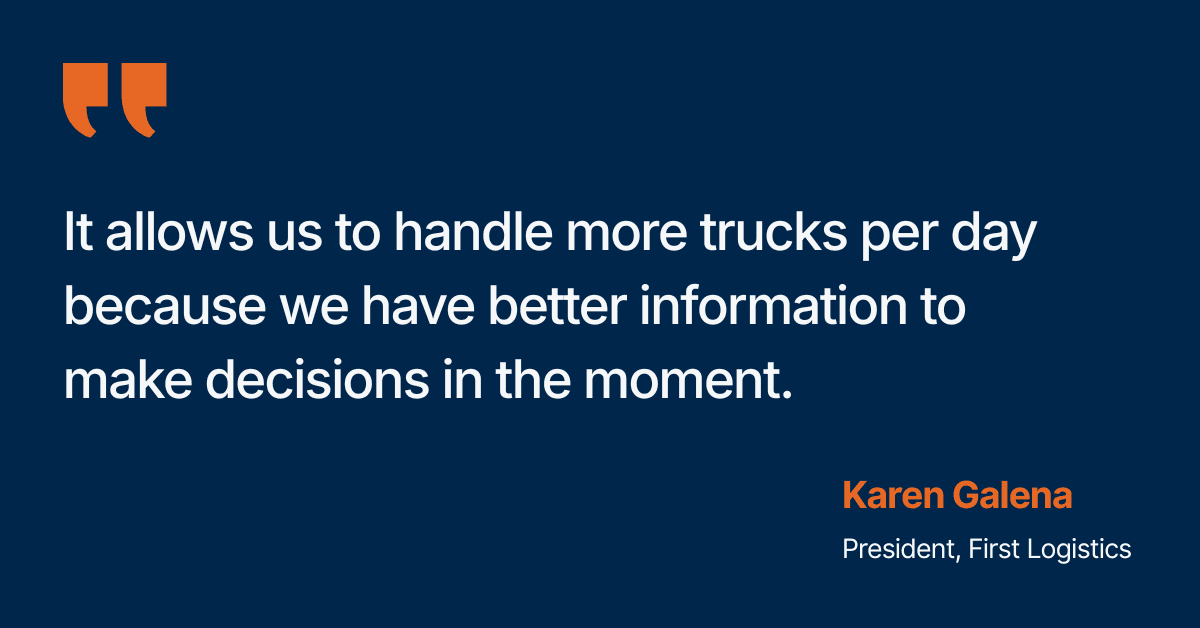
For Galena, that comes back to better operational control. “It allows us to handle more trucks per day because we have better information to make decisions in the moment,” she said.
The result has been a 25% increase in trucks processed per day.
3 hours saved per day for the customer service team
Conduit also reduced the amount of manual coordination around appointments.
With carriers booking through the portal and fewer status calls to manage, that workload has dropped significantly. First Logistics estimates that CSRs save roughly three hours per day on scheduling and status follow-up.
That time has gone into higher-value work. As Don put it, Conduit has “lightened that load,” allowing the customer service team to focus more on customers and less on carrier coordination.
Thousands saved in detention
One of the clearest operational improvements has been detention. Before Conduit, disputes with carriers were difficult to resolve because paper logs didn't provide defensible proof of when drivers actually arrived or how long loading took.
Now, every load has a time-stamped record: driver check-in, loading start and completion, and driver logout. When a carrier disputes a charge, First Logistics can point to the data or simply give them portal access to see it themselves.
"We give them access to the portal and say, 'Here, you can check it yourself — this is when the driver was here and when the driver was not here,'" Don explained.
The result has been clear: "We have not had to pay one detention charge since the implementation of Conduit," Don said, "which has saved us thousands of dollars."
More transparent QBRs with carrier scorecards
In quarterly business reviews, First Logistics uses Conduit’s carrier scorecards alongside warehouse metrics to help customers understand what is affecting service levels.
Those scorecards include carrier-related data such as on-time arrivals, late arrivals, and missed appointments. For customers who manage their own transportation, that information is especially valuable because it helps separate warehouse issues from carrier issues.
This level of transparency strengthens the customer relationship and positions First Logistics as a strategic partner, not just a warehouse provider.
Benchmarks for labor, capacity, and pricing
First Logistics uses Conduit to track loading and unloading activities by customer, product type, and handling requirement.
“It gives us a baseline for how long it should take people to do things, and what the averages are,” said Don.
That helps the team plan labor more effectively and make more informed capacity decisions.
“We can increase volume because we know how long it takes to load or unload a truck with a given number of pallets,” he added.
It can also support pricing decisions by showing how long different types of work actually take.
For a multi-client 3PL handling a wide range of products and service requirements, those benchmarks make it easier to turn operational data into better business decisions.
Conclusion
For First Logistics, Conduit solved more than a scheduling problem. It gave the team a better way to manage the day-to-day complexity of a multi-client operation.
By replacing manual scheduling, in-person driver check-in, and scattered records with one system, First Logistics gained control over daily execution, more proof when questions or disputes arise, and better data to guide labor, capacity, and customer conversations.
For a multi-client 3PL, that kind of structure matters. “It’s not just a scheduling tool,” said Don. “We use it as a multifaceted tool within our business.”

Get Started
Resources
Contact